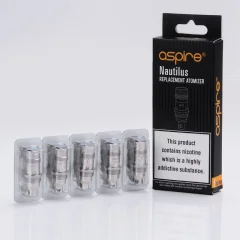
Aspire Coil is the general name for the replaceable coil families produced for Aspire brand electronic cigarettes, pod, and atomizer systems. Aspire's product range includes a wide variety of options, from high-resistance coils for MTL usage to low-resistance DTL mesh coils that can reach 80–100W levels.
Current Aspire coil platforms include various distinct systems such as Nautilus, BP, AF, Cloudflask, PockeX, and BVC. These coil families differ in their physical connections, resistance options, and compatible devices.
When choosing an Aspire coil, looking only at the ohm value is not enough. First, the coil family supported by the tank, pod, or device you are using must be checked, followed by the coil resistance and the recommended wattage range.
The shortest answer to the question "What is an Aspire Coil?" is that it is the replaceable consumable part used to heat e-liquid in Aspire brand tank and pod systems.
A pre-built Aspire coil generally contains;
When the device is fired, the coil heats up, and the e-liquid reaching the cotton turns into an aerosol.
To examine different brands and models of coil types, you can check the Coil category.
Aspire Coil types do not consist of a single product family.
Aspire Nautilus Coil is one of Aspire's coil families with the widest compatibility.
In addition to classic high-resistance BVC coils, the Nautilus platform also includes current, lower-resistance, and mesh-structured options.
The current Nautilus coil family is used with multiple Aspire tanks and Zelos devices.
Examples of current compatible tanks include;
However, not all Nautilus coils are required to work on all older Aspire devices. Especially in older pod or AIO devices, supported coil options may be more limited.
Do not rely solely on the "Nautilus compatible" information when buying Nautilus coils. Check that your tank or device supports the resistance value you have chosen in the Aspire compatibility chart.
The Nautilus Mesh 0.3Ω coil is specified by the manufacturer to operate in the 23–28W range.
It is a lower-resistance and higher-power option compared to high-resistance classic Nautilus MTL coils.
The recommended power range for the Nautilus 2S 0.4Ω coil is at the 23–28W level.
The 0.4Ω value does not mean the same wattage or compatibility as all 0.4Ω coils from the same or other brands.
There are two different 0.7Ω coil options in the Nautilus family.
18–23W operating range.
20–25W operating range and mesh heating structure.
Even if the resistance values are the same, the coil structure and recommended wattage ranges are different.
The Nautilus Mesh 1.0Ω coil is listed in the 13–15W operating range.
It is among the high-resistance and low-power MTL options.
The Nautilus BVC 1.6Ω coil is one of Aspire's classic high-resistance MTL options.
It is included in the manufacturer's current Nautilus coil list with a 7–11W operating range.
The Nautilus BVC 1.8Ω coil has a 10–14W operating range.
It continues to be used in many Nautilus tanks with its high-resistance classic BVC structure.
Aspire BP Coil is a coil platform that offers a very wide range of resistance and wattage options, from MTL to high-power DTL usage.
The BP coil family is used in various Aspire devices and tanks.
In the current platform, different products in the Veynom, BP Stik, Rhea X, and Huracan families may support BP coils.
However, the important point is: not all BP coils can be used in all BP-compatible devices.
For example, while the BP Stik supports;
coils, it does not support the BP Pro Mesh 0.15Ω 80–100W coil.
Being in the same coil family does not mean complete compatibility. The device's maximum wattage capacity and the manufacturer's coil compatibility table must be checked.
The BP Pro Meshed 0.15Ω coil is one of the highest-power options in the Aspire BP family and operates in the 80–100W range.
It can be used in compatible devices such as the Veynom LX, Veynom EX, and specific Huracan/Rhea systems.
It cannot be used in models like the BP Stik, where the maximum power capacity is not suitable for this coil.
The standard BP Meshed 0.15Ω coil has a 60–80W operating range.
Although it carries the same resistance value as the BP Pro 0.15Ω, its wattage range and some device compatibilities are different.
The BP Meshed 0.17Ω coil operates in the 45–55W range and is one of the low-resistance DTL options.
A 30–40W operating range is specified by the manufacturer for the BP Meshed 0.3Ω coil.
The BP Meshed 0.4Ω coil has a 25–35W operating range.
It is one of the options used at a more medium power level in the BP platform.
The BP 0.6Ω coil is found in the 15–25W operating range.
It is one of the low-power BP options and can be considered for devices that want higher resistance usage.
The BP 1.0Ω coil is one of the high-resistance Aspire coil options operating in the 10–16W range.
Aspire AF Meshed Coil is a coil platform used particularly in the Flexus device family and products like the AF Tank.
Current AF coil options have different resistance options such as;
The AF coil family is used with many Aspire Flexus products.
Depending on the model and resistance option, current compatible systems include;
However, it should not be assumed that higher-power options like the 0.4Ω coil are used in all older AF devices.
The AF Meshed 0.4Ω coil is in the 20–28W operating range.
It is one of the lower-resistance and higher-power options in the AF family.
The AF Meshed 0.6Ω coil operates in the 15–18W range.
It is one of the common AF options that can be used between MTL and more open draws.
The AF Meshed 0.8Ω coil has a 14–16W operating range.
It is one of the resistance options supported in current devices like the Flexus SE.
The AF Meshed 1.0Ω coil is a higher-resistance MTL option operating in the 12–15W range.
Cloudflask Coil is a mesh coil platform exclusive to the Aspire Cloudflask product family.
Current devices such as the Cloudflask X and Cloudflask III can support these three resistance options.
Aspire PockeX Coil is a dedicated U-Tech coil platform prepared for the PockeX device family.
SS316L coil with an 18–20W operating range.
Kanthal coil with a 10–12W operating range.
The PockeX coil is physically and technically not the same as the Nautilus, BP, or AF coil families.
BVC stands for Bottom Vertical Coil and is one of Aspire's classic coil technologies.
In Aspire's General BVC platform, there are options such as;
This coil family can be used in K1, K Lite, and some classic Aspire clearomizer systems.
Despite the name similarity, General BVC and Nautilus BVC are not the same coil platform. Since the term “BVC” can be used in different physical coil families at Aspire, the exact product name must be checked.
Mesh coil is a coil technology that uses a wider surface, net-like heating structure instead of a classic round wire.
Mesh options are found in a significant portion of Aspire's current coil platforms.
The mesh structure is used in different Aspire coil families such as;
The word "mesh" by itself does not indicate whether a coil is MTL or DTL. At Aspire, there are both 1.0Ω low-power mesh coils and 0.15Ω high-power mesh coils.
There is a fairly wide range of resistance in Aspire coil products.
These ranges are for general classification purposes. The actual wattage and compatibility information specified by Aspire for each coil should be taken as the basis.
The correct wattage to be used for an Aspire coil is the range specified on the coil or in the manufacturer's technical page.
For example, there are large differences such as;
The same ohm value does not mean the same wattage. For example, two different 0.15Ω Aspire coils may have different power ranges, such as 60–80W and 80–100W.
While Aspire's Nautilus and AF coil platforms offer primarily MTL/RDTL options, the BP and Cloudflask platforms also include high-power DTL options.
When choosing an Aspire coil, the following sequence can be used:
No.
Being an Aspire brand does not automatically ensure coil compatibility.
For example;
are physically and technically different coil systems.
Not always.
Even within the same coil family, some resistances may not be supported due to the device's maximum power output or the tank/pod design.
The BP Stik is a good example of this. While the device supports the standard BP 0.15Ω coil, it does not support the higher-power BP Pro 0.15Ω coil.
For this reason, the full device compatibility list should be checked instead of just "BP compatible" or "Nautilus compatible" labels.
After a new Aspire coil is installed, the cotton inside the coil should be allowed to absorb the e-liquid sufficiently.
Once the coil is installed, the tank or pod is filled, and the waiting time specified by the manufacturer for the product is applied before the device is fired.
This time can vary according to the device and liquid structure in Aspire's various product instructions. For example, it is indicated that you should wait approximately 2–3 minutes to saturate the cotton for the PockeX, while for some current Aspire systems, it is recommended to wait approximately 5 minutes.
A new Aspire coil should not be dry-fired. Firing the coil before the cotton is sufficiently saturated with e-liquid can cause a burnt taste and early coil damage.
Priming is the process of completely saturating the cotton inside a new coil with e-liquid before the first use.
Waiting after the tank or pod is filled is the basic method of the coil priming process.
In some coil designs, applying e-liquid to the visible cotton intake holes in accordance with the manufacturer's usage instructions may also be possible.
It is not correct to give a single definite time for all Aspire coils.
The recommendation from the manufacturer may change depending on the coil structure and the e-liquid used.
In general, the device should not be operated until the cotton section of the coil has completely absorbed the e-liquid.
There is no fixed number of days for Aspire coil life.
Coil life can be affected by;
When an Aspire coil completes its service life, one or more of the following signs may be seen:
There can be different reasons why a coil is damaged in a shorter time than normal.
A persistent burnt or dry cotton taste may indicate that the coil has been damaged.
If a new coil gives a burnt taste during its first use, the cotton may have been fired before absorbing enough e-liquid.
If a coil that has been used for a long time starts to give a burnt taste, the coil may have completed its service life.
Dry Hit is the condition of a dry and burnt taste that occurs as a result of firing the coil when the coil cotton is not carrying enough e-liquid.
Situations that may increase the risk of Dry Hit include;
Aspire pre-built coils are consumable products where the metal housing, cotton, and heating element are all together.
A finished pre-built coil is not designed to be re-wicked or completely renewed under normal use.
In case of a distinct burnt taste or loss of performance, it should be replaced with a suitable new coil.
Suitable low-power Aspire MTL coils can be used with Salt liquids.
However, not all Aspire coils are suitable for particularly high-nicotine Salt liquids.
For example;
Low-wattage options such as 1.0Ω, 1.6Ω, or 1.8Ω are among the systems more frequently preferred for Salt liquid usage.
Coils that require high power, such as 0.15Ω and 60–100W, should not be evaluated in the same usage class as high-nicotine Salt liquids.
You can check the Salt Liquid category for Salt liquid options.
Freebase e-liquids with appropriate nicotine concentration and VG/PG ratio can be used in Aspire coil systems.
Low-nicotine Freebase formulations are in the common usage class for low-resistance and high-power BP or Cloudflask DTL coils.
There are also Freebase liquid options suitable for MTL usage.
The correct VG/PG ratio is not determined solely by the Aspire brand name.
The coil's;
must be evaluated together.
While more fluid liquids are common in high-resistance, low-power MTL coils, high-power DTL coils can support higher VG ratios.
The coil replacement method differs according to the Aspire device used.
In some systems, the coil is pulled out from the bottom of the pod, while in some tanks, it is removed via the base or top cap.
For example, in the BP Stik, the old coil is pulled out after the pod is removed from the device, and the new coil is pressed into place.
In the PockeX, the coil has a screw-type structure to the top cap system.
Do not force the coil when installing it. If the coil is not in the correct orientation or connection, you may damage the tank/pod o-ring.
Improper installation of the coil or damage to the coil o-ring can be one of the reasons for leakage.
Leakage can also be caused by;
Not every leak means direct coil failure.
The best Aspire Coil is not the same resistance or coil family for everyone.
First, the coil platform supported by the Aspire device you are using must be determined.
Aspire Coil prices can vary according to the coil family, resistance value, technology used, and the number of products in the package.
Different packaging options, such as three-packs and five-packs, can be found for Aspire's current coil products.
When making a price comparison;
should be evaluated together.
Coil resistance and package quantity are important comparison criteria for Nautilus Coil prices.
Since there are different options in the Nautilus platform such as 0.3Ω, 0.4Ω, 0.7Ω, 1.0Ω, 1.6Ω, and 1.8Ω, you should not make a selection solely based on the "Nautilus Coil" name when purchasing.
Standard BP and BP Pro options must be distinguished from each other in BP Coil price comparison.
Although the 0.15Ω standard BP Mesh and the 0.15Ω BP Pro Mesh have the same resistance, their operating power and device compatibility are different.
The AF coil family includes 0.4Ω, 0.6Ω, 0.8Ω, and 1.0Ω mesh options.
When comparing prices, it should be checked whether the Flexus or AF system used supports the chosen resistance, along with the package quantity.
When evaluating buy Aspire Coil options, first determine the exact model of your device and the tank/pod system.
Then, check the information in the product description;
Do not select a coil based solely on the Aspire brand name or only on the ohm value.
No. Aspire has different coil platforms such as Nautilus, BP, AF, Cloudflask, PockeX, and BVC.
No. Physical structure, resistance options, and compatibility are different.