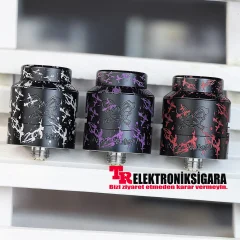
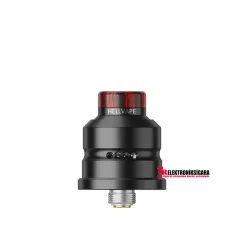
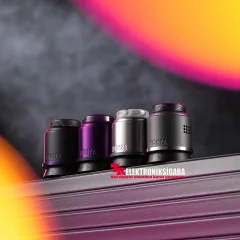
RDA and RDTA atomizer models are among rebuildable atomizer systems where the coil and cotton can be prepared by the user. In both structures, coil builds can be made on the build deck; the primary difference is how e-liquid is fed to the coil.
While e-liquid is mostly dripped directly onto the coil and cotton in RDA models, RDTA atomizers feature an e-liquid reservoir located beneath the build deck section, allowing the cotton ends to feed liquid from this tank.
RDA stands for Rebuildable Dripping Atomizer. Falling into the rebuildable atomizer class, RDA models allow users to perform their own coil and cotton builds.
Unlike traditional tank systems, an RDA does not have a large liquid reservoir. It is used by dripping e-liquid directly onto the coil and cotton. A juice well capable of holding a limited amount of liquid may be located beneath the build deck.
RDTA stands for Rebuildable Dripping Tank Atomizer.
RDTA models bring together the build deck structure of RDA atomizers and the liquid capacity of tank systems. The deck is typically located above the tank section, and the cotton ends are fed from the liquid reservoir below.
Thus, while offering an RDA-like coil placement, it can reduce the need to drip liquid repeatedly with every use.
The most distinct difference between RDA and RDTA is the liquid reservoir.
Both systems are designed for users who want to make their own coil and cotton builds.
In an RDA atomizer, the coil is built onto the build deck and appropriate cotton is inserted. Once the cotton is fully saturated with e-liquid, the atomizer can be used.
Since there is no tank capacity in an RDA, e-liquid must be re-added at certain intervals before the cotton dries out.
In an RDTA atomizer, the coil is placed in the build deck section located on top of the tank. The cotton ends extend toward the liquid reservoir.
The liquid inside the tank is transported to the coil by the cotton. This structure maintains the RDA-style deck usage while offering the advantage of a separate liquid reservoir.
Depending on the build deck design, single-coil or dual-coil builds can be made in RDA and RDTA atomizers.
In single coil systems, a single coil is used, whereas in dual coil builds, two coils operate simultaneously. As the number of coils changes, total resistance, power requirement, liquid consumption, and battery load can also change.
Some RDA atomizer models feature a bottom-feed or squonk pin. These models can be used with squonk mods.
In a squonk system, e-liquid is sent from the squeezable bottle inside the mod through the connection pin directly to the deck section of the RDA. Thus, the need to constantly drip liquid from the top can be reduced.
In rebuildable RDA and RDTA systems, coil and cotton selection can directly affect atomizer performance.
Coil diameter, wire structure, resistance value, and number of coils must be compatible with the build deck being used. The amount of cotton should be adjusted to allow regular liquid feeding.
Too much cotton can restrict liquid feeding, while insufficient cotton can lead to issues such as leaking or inconsistent feeding.
E-liquid selection should be made based on the established coil resistance, the wattage value used, and the build structure.
In DL / DTL-focused RDA and RDTA setups used at low resistance and high power, low-nicotine Freebase e-liquids with a high VG ratio are commonly preferred.
You can check our Premium E-Liquid category for Freebase options.
The main feature of an RDA system is that the build deck section is directly accessible and the coil and cotton builds can be made by the user.
Due to the lack of a tank, switching to different e-liquids can be faster compared to some tank systems. In exchange, e-liquid needs to be added to the cotton more frequently.
The primary difference of the RDTA structure is that it combines an RDA-like build deck with tank capacity in the same atomizer.
Thanks to the tank section, the cotton's liquid feeding can last longer, and manual dripping may not be needed as frequently as in an RDA.
When choosing an RDA or RDTA atomizer, atomizer diameter, connection type, build deck design, single or dual coil support, and airflow system should be evaluated together.
If an RDA is preferred, squonk compatibility, juice well depth, and deck usability can be examined; if an RDTA is preferred, tank capacity and the cotton feeding system can also be reviewed.
RDA and RDTA atomizer prices may vary depending on the brand, model, materials used, deck design, airflow system, box contents, and spare parts.
More complex build deck designs, squonk pins, spare glass, drip tips, or different airflow components included in the box can affect the price.
When comparing RDA / RDTA atomizer varieties, you should evaluate not only design or price, but also deck structure, coil support, airflow, tank requirement, squonk compatibility, and device dimensions together.
Users who want a simpler and direct dripping system can consider RDA models, while users who want an RDA-type deck combined with an e-liquid reservoir can consider RDTA options.
RTA, RDA, and RDTA models all belong to the rebuildable atomizer family.
In an RTA, the build deck is generally located within the tank and chimney system. In an RDA, there is no large liquid tank; in an RDTA, the build deck is positioned above the tank section.
To examine other atomizer systems, you can check out our main Atomizer category.